
Cheshire City Directory Collections
Cheshire's directory history lives in two places. The local shelf sits at Cheshire Public Library. Its public page confirms city directories among the local-history holdings, though it does not name the publisher or list the year-by-year run. The digital side is more open. The Library of Congress publishes a digitized Cheshire telephone-directory run labeled April 1954 through 1961/62. These are different evidence classes. One needs a shelf visit or a staff query, while the other is an open page image showing a name, street, exchange, and telephone structure at a glance.
| Collection | Years | Where Held | Access |
|---|---|---|---|
| Cheshire Public Library directory volumes | Exact shelf years not published online | 104 Main Street, local-history collection | Ask staff; in-person research |
| Reverse or criss-cross directories | Exact Cheshire run not published online | Library or local archive, if held | Confirm with staff before relying on it |
| Library of Congress Cheshire telephone directories | April 1954 through 1961/62 | Library of Congress digital collection | Open online page images and text |
| Cheshire Newspaper Articles Index | 1756-1922, incomplete and gapped | Cheshire Public Library | Index citation and copy request |
| Cheshire Herald obituary index | 1953-2015, A-R identified | Cheshire Public Library | Index citation and copy request |
Questions remain about the local printed series. The library's public pages do not state the publisher or the annual run. The reverse, or criss-cross, series has the same gap. No source publishes a first local volume. No source records a publisher change. No source gives a last printed year or a full list of missing years. Take those questions to the library catalog or the local-history staff. Filling the blanks from another town's catalog would only mislead.
Inside the Cheshire City Directory Shelf
Cheshire Public Library, 104 Main Street, is the best local starting point for historical people research. Its local-history holdings span town, county, regional, and state histories, local family histories, high-school yearbooks, directory volumes, Hale cemetery inscriptions, and Barbour Connecticut vital-record abstracts. That mix matters. A name found in a directory can be tested against a family, cemetery, or vital clue, so one old listing never has to carry a full life story on its own. The Cheshire History collection page lays out the library's local-history and index routes. It identifies the Cheshire Newspaper Articles Index, covering 1756-1922 with known gaps. The Cheshire Herald obituary index runs 1953-2015, but only the A-R segment is identified so far. Complete citations can go further. For those, the library can email a copy of an indexed article or obituary. The request form asks for a name, email, message, and submission.
The library's research page shows how local access works beyond the shelf: review Cheshire Public Library research services before planning a visit.
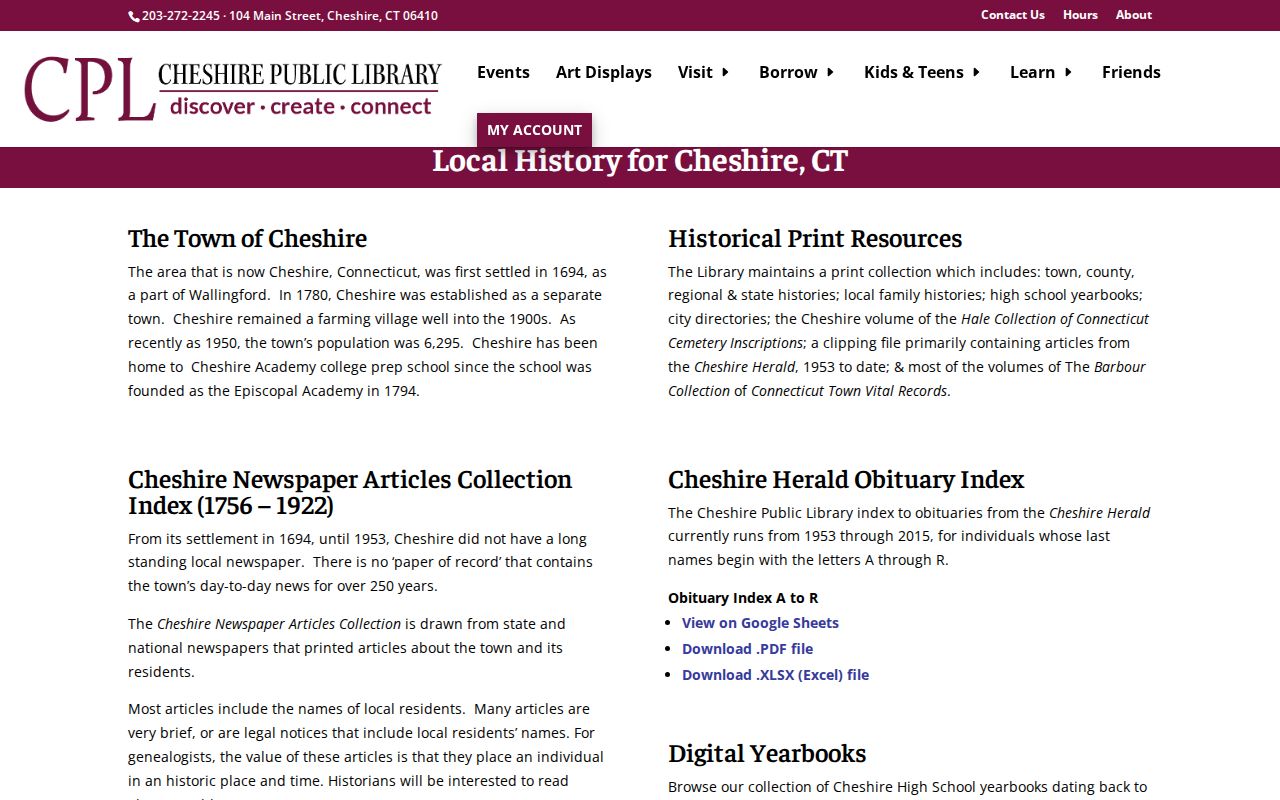
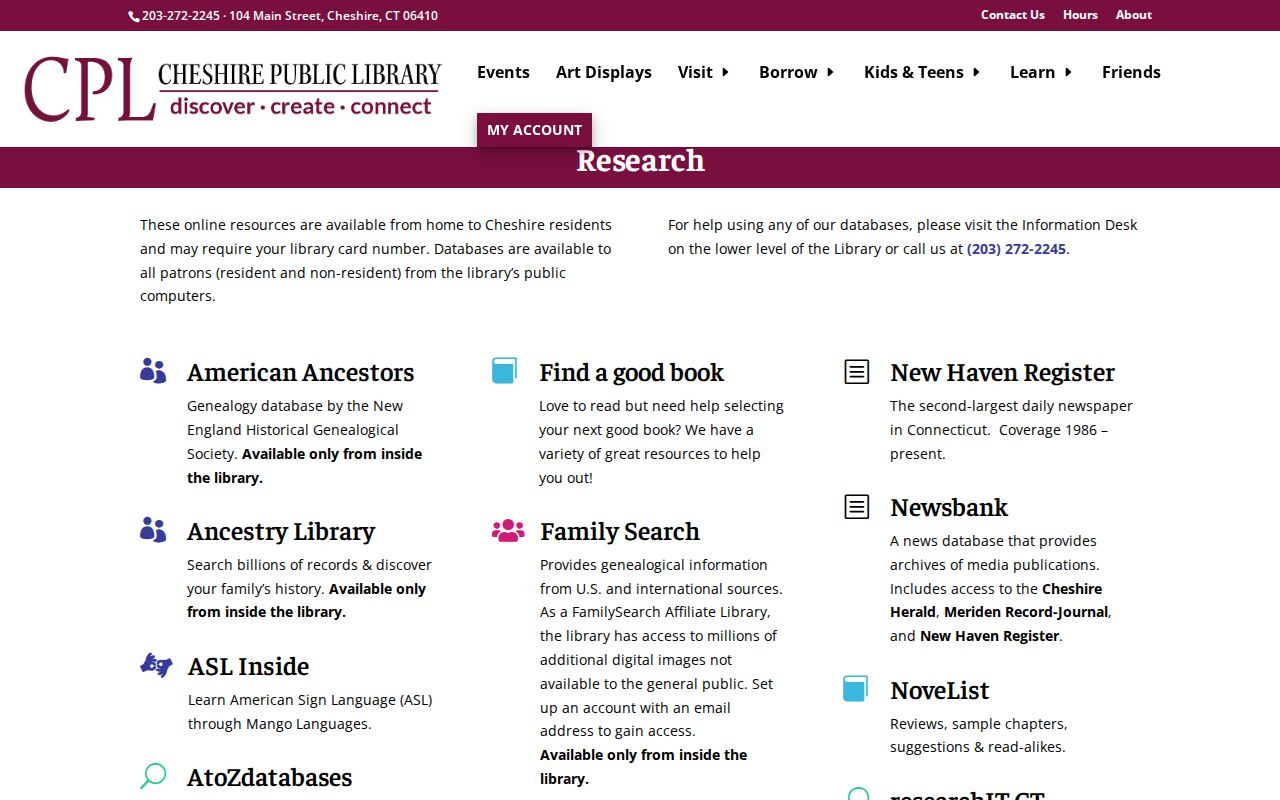
The library's public contact is 203-272-2245. Remote database use may require a Cheshire resident library card, while on-site public computers are available to all. The research page lists Cheshire Herald 2006-present, New Haven Register 1986-present, Meriden Record-Journal 1997-present, Historic Hartford Courant 1764-1922, NewsBank, Ancestry Library Edition, and FamilySearch Affiliate access. Current licensing rules control which databases work from home.
The Cheshire City Directory Telephone Run
The strongest telephone-directory evidence sits in a Library of Congress collection labeled “Connecticut - White Pages and Yellow Pages - Cheshire - April 1954 thru 1961/62.” This is a telephone run rather than a general annual town directory. That matters. The Cheshire directory format still carries real value. It pairs each name with a street address, an exchange, and a telephone number. It also splits personal and business listings into white-page and yellow-page sections. The result is a dated record of how a Cheshire name connected to a street.
The page image can be checked in the Library of Congress Cheshire telephone-directory resource.
Treat a 1950s telephone entry as a historical snapshot. It can place a name near a Cheshire street during the run. It cannot prove a present number, present address, or present household. Preserve the issue or page reference. Transcribe the printed street and exchange exactly. Then set the entry beside the 1950 federal census or a local historical source. A missing number does not mean the person had left town. The entry may be absent, abbreviated, or simply sit outside the page in view. Careful reading beats guesswork here. Cross-checking the Cheshire residents directory entry against another record keeps the lookup honest.
Reading a Cheshire City Directory Entry
A Cheshire city directory entry works as a small record. It carries a date, a key, and limits. The telephone run verifies a surname or household listing. It also confirms a street number and name, an exchange, and a telephone number. It does not verify features from some other publisher's volume. Layouts differ on the local shelf. So photograph or note the contents page and abbreviation key. Do this before interpreting any mark in a Cheshire street directory volume.
| Name | Surname and given name, or a household or business listing, as printed. |
|---|---|
| Address | Street number and street name when the listing includes them. |
| Exchange and phone | The telephone exchange and number visible in the digitized run. |
| Occupation | Not verified in the inspected Cheshire telephone structure; check the local volume before using this field. |
| Spouse or household note | Not verified in the public sample; do not infer a relationship from a shared surname. |
| Owner or renter mark | Not verified in the published Cheshire sources; a local publisher's symbol must be explained by its own key. |
That distinction matters for accuracy. A field common in one directory volume may be absent from another. The safe claim is what the page actually prints. Follow it with the date and collection name. For a name with several entries, compare street, exchange, household wording, and neighboring listings. Only then treat two appearances as one person.
- Criss-cross directory
- A reverse directory arranged by street or address rather than by surname. Cheshire's exact reverse run is not published online, so its years and format need a staff check.
- Householder index
- A name-first aid that points to a head-of-household entry or page. Confirm whether a local volume includes one before searching for it.
- Abbreviation key
- The publisher's explanation of short forms and symbols. Read it before treating a mark as a family, address, or listing clue.
A Cheshire City Directory Timeline
A Cheshire city directory timeline has to stay modest. The record landmarks that can be documented are real. What cannot be pinned down is the first printed local directory, the publishers behind it, or the year the final volume rolled off the press. A chronology built on the sources that actually exist still gives a Cheshire residents directory search something firm to stand on.
- 1780: Cheshire became a separate town from Wallingford, and the Town Clerk's IndexBooks are documented back to 1780-1931.
- 1897: Connecticut's statewide vital-record system begins its documented coverage, making later certificate research a different route from earlier town and church material.
- April 1954 through 1961/62: the Library of Congress preserves the digitized Cheshire telephone-directory run.
- 1955 onward: Cheshire High School yearbooks are available through the library's digital yearbook catalog.
- 2026 research boundary: the public library still confirms the local directory collection without publishing its exact shelf run or reverse-directory details.
Treat each dated source as its own kind of evidence. IndexBooks lead to land-record names and book pages. A telephone run belongs to the address era of listings. Yearbooks speak to school identity, not residency. Keep each citation separate in your notes. Then a later Cheshire directory search never collapses three different record types into a single claim.
Cheshire Directory Archive Visits
A printed directory can leave a property or family question open. The Cheshire Historical Society offers another route. Its archive holds historic-property files along with documents, letters, journals, artifacts, photographs, and ephemera. The Society does not present that material as a universal online name index. A focused question works better than a broad sweep. An appointment with the archivist can connect a person or an address to records that no search box exposes. For a Cheshire resident lookup that hits a wall, that personal touch makes the difference.
The Society's own archive and local-history page is the source for its appointment route and collection context.
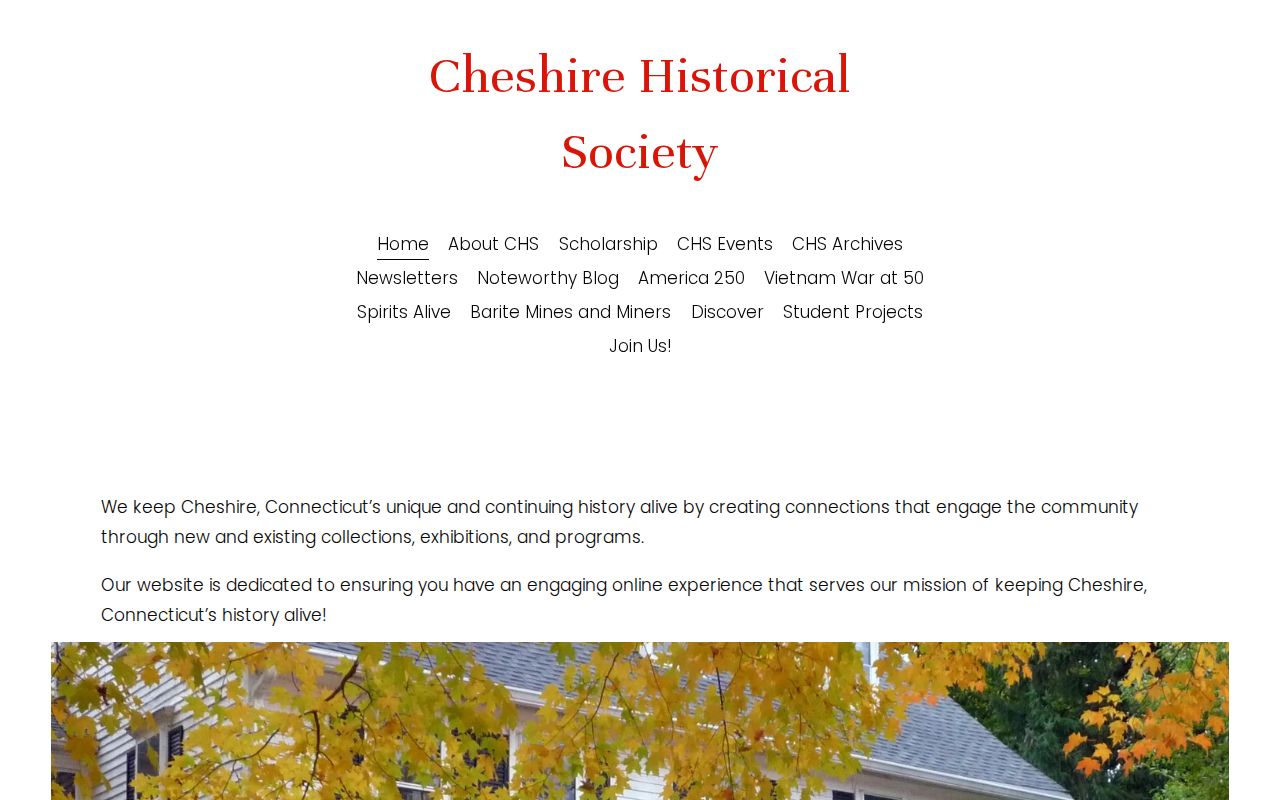
Reach the Cheshire Historical Society at 43 Church Drive, Cheshire, call 203-272-2574, or write cheshirehistorical@gmail.com. The Society suggests arranging time with the archivist for specified weekends or Thursday afternoons. Bring a name, a dated address, and the question the directory could not answer. The archive supports house history and local context. Do not treat a photograph or letter as proof of current residence. It can still enrich a past residents search.
The Connecticut State Library widens the historical net. Its research route leads to catalogs, the CT Digital Archive, and finding aids. Ask Librarian and State Archives material are there as well. Certification rules cover eligible official or probate records only. Newspaper pages, family-history resources, and electronic collections fall outside that rule. The difference matters when a historical lead must become an official copy for a records office.
Cheshire Directory, Yearbook, and Hale Clues
A few Cheshire collections let you pressure-test a directory name. None of them should be mistaken for a current resident roll. The digital yearbook catalog opens in 1955. It can tie a former classmate to a school year. It can also point to a portrait, an activity, or a printed address clue. Hale cemetery inscriptions add another angle. They supply a death date, a burial location, or a family relationship. Barbour abstracts point toward a Connecticut town birth, marriage, or death record. Each collection answers a different question. Cite each one as a lead, never as the certificate itself or a current address.
- Use a yearbook to establish school-era identity and a class year.
- Use Hale inscriptions to test a cemetery or death clue.
- Use Barbour abstracts to identify a vital-record event worth verifying.
- Use the newspaper index for legal notices, events, and dated names.
- Use the obituary index for a death or household endpoint, remembering that only A-R coverage is identified.
The library also offers access to a deep bench of newspaper and genealogy databases. Cheshire Herald coverage runs from 2006 to the present. Historic Hartford Courant spans 1764 to 1922. The New Haven Register dates from 1986, and the Meriden Record-Journal from 1997. NewsBank, Ancestry Library Edition, and FamilySearch Affiliate resources round out the set. A directory entry, obituary index line, or abstract is only traceable if the source date travels with it. The collection label must carry through too.
Pair Cheshire Directory Years With the Census
A name gains real weight when two dated sources agree. The federal 72-year release rule governs census access. That makes the 1950 enumeration the most recent decennial census open to the public. A Cheshire telephone entry from the late 1950s can therefore sit beside the 1950 census to bracket a household, then be checked against yearbooks, the newspaper index, or a deed and parcel clue. Remember what the census actually is: a household snapshot. It never guarantees that everyone listed stayed at that address.
- Write down the directory issue, page, name, street, exchange, and number exactly as printed.
- Search the 1950 census for the same surname, household members, age pattern, and local street context.
- Compare the address and household wording, allowing for spelling, marriage, death, and movement between the two dates.
- Test the result against a Cheshire yearbook, newspaper citation, obituary index line, or cemetery source.
- Keep each source separate in the notes, with its date and what it can actually prove.
When a name drops out of the Cheshire directory, several explanations stay on the table. The household may have moved. A person may have died or married. The volume may have skipped a year. Or the listing may simply never have appeared. A later deed, obituary citation, or cemetery record can explain the change. A blank page alone cannot.
When the Cheshire Directory Trail Stops
Some trails simply end. Exact local publisher names, shelf years, and reverse-directory runs never made it online in Cheshire. The newspaper index is incomplete, and the obituary index covers only surnames A through R. That Library of Congress telephone page is a historical listing, not a current directory. When an online result runs dry, the paths still hold up. Ask the library to identify a volume or citation. Ask the Historical Society whether a property file exists. The State Library catalog, paired with its Ask Librarian route, reaches a far wider collection than any single town shelf.
A record request works better when it is specific. Name the person or address, the record type, and the date range you want searched. The Cheshire Town Clerk keeps land and vital records locally, while the library and the Historical Society hold different historical materials for the same residents directory era. A dated entry can still be cross-checked against modern sources. The Cheshire resident lookup workflow separates an assessor clue from a voter result, a court index, or a vital-record route, so an old directory line never gets treated as a present-day fact.
Note: A no-result can mean an unlisted entry, a gap, a spelling change, a protected record, or a volume that was never digitized.