
How Cheshire Residents Are Found
There is no single current roster of everyone in Cheshire. Ownership clues come from the Cheshire Assessor Property Search and MapXpress parcel layer. Registration information comes through Connecticut’s MyVote route and the local Registrars. Court, vital, business, and license records each describe a person in a different setting. For an older household, the Cheshire Public Library and the Library of Congress telephone run are more useful than a current parcel card.
The strongest start depends on the question. A known address calls for a parcel and deed path. A full name calls for a name search followed by a location check. A family-history question calls for dated directories, newspaper citations, yearbooks, probate, or cemetery material. A current result can be absent because a record is protected, aged out, not indexed, or held only at a counter.
- Write down the name, address, town, and date or era you are testing.
- Use the assessor or GIS to anchor a known address to a parcel, MBL, or unique identifier.
- Check the Connecticut court or MyVote route only for the record type it actually displays.
- Use the Town Clerk’s deed, map, or vital-record channel for a custodian-level answer.
- For an older person or address, ask the library or Historical Society for a citation before requesting a copy.
That sequence keeps the Cheshire residents directory grounded in records that have a keeper, date, and stated access rule. It also keeps an owner, voter, court party, and historical listing from being treated as the same thing.
Cheshire Resident Records Offices
Cheshire is in New Haven County, but Connecticut counties are geographic divisions rather than operating county governments. There is no New Haven County recorder for Cheshire deeds and no county jail roster to substitute for a local record. The Town Clerk, state Judicial Branch, Department of Public Health, Secretary of the State, and local library form the practical record map.
The Town Clerk page is the local fallback for deeds, maps, municipal records, and vital certificates when an online index does not answer the question. The assessor supplies an ownership and parcel clue, not a statement that every person at the situs lives there. The library supplies historical citations and research help, while the state portals supply rules that a town page cannot replace.
Note: Town Hall is the shared physical anchor for several Cheshire record custodians, but each office controls a different record set.
Cheshire’s Town-Centered Records Map
One useful Cheshire detail is what is missing. A searcher expecting a county recorder, county clerk, or county jail will be sent in the wrong direction. Deeds are filed with the Town Clerk. Superior Court matters are state records routed through the New Haven Judicial District and Meriden GA 7. Probate is handled by the Cheshire-Southington Probate Court. Custody checks go to the Connecticut Department of Correction or the federal Bureau of Prisons, not a New Haven County jail page.
The local map is compact. Town Clerk, Assessor, Collector of Revenue, and Probate contacts all use the Town Hall address. MapXpress turns the parcel layer into a public map, with property information updated nightly and parcel edits reported for March 2026. That shared local system is why an address can move from a property card to a map, then to a deed or planning notice without leaving Cheshire’s municipal record chain.
The visual record below comes from the Town of Cheshire land-record page, which explains the historical IndexBooks and the office fallback. It is a useful reminder that a search result may be an index or a scanned image, not both.
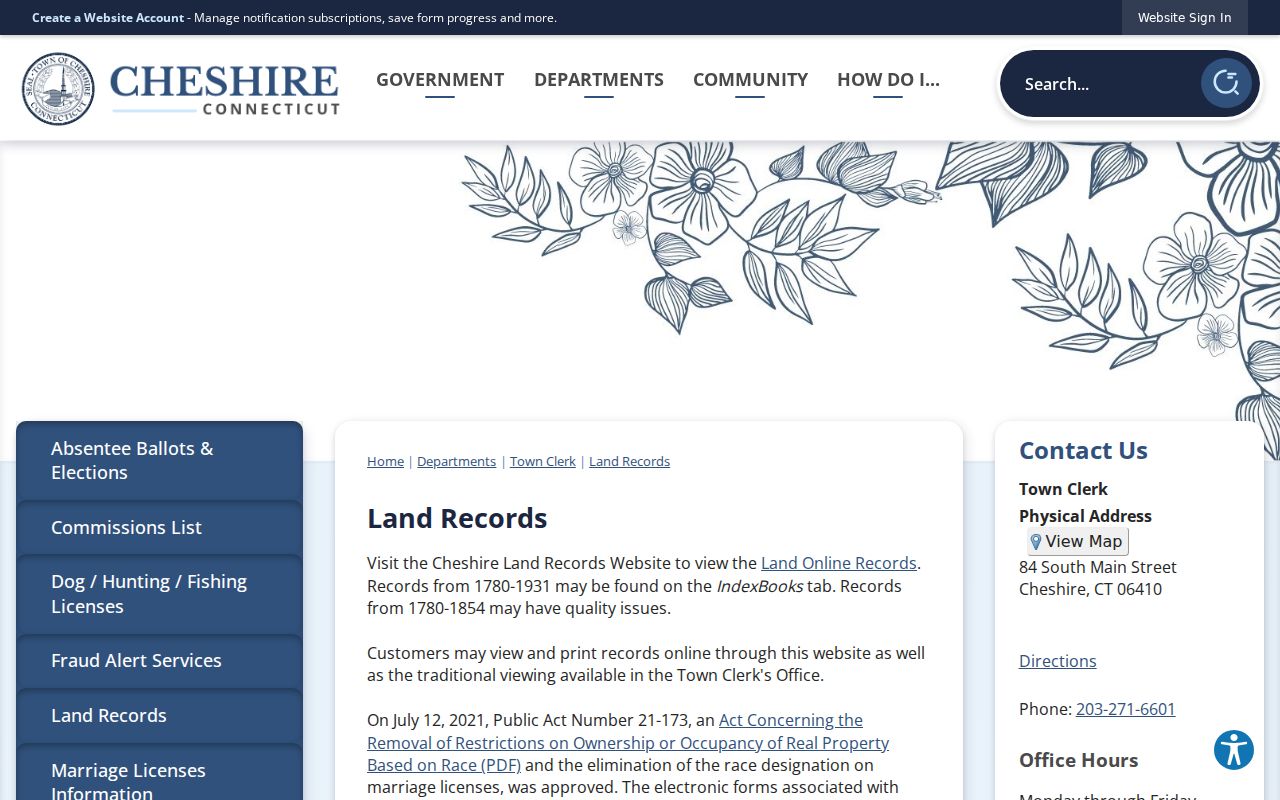
The local land page identifies IndexBooks from 1780 through 1931. SearchIQS help separately describes Cheshire land index and image coverage from July 1928 forward, with older record-book images listed for 1851 through 1937. Those descriptions overlap but should not be flattened into one claim about every image.
Cheshire Property Records Behind the Residents Directory
The assessor is often the first practical stop when an address is known. The free portal has separate Property Search and Sales Search tabs. Its results can lead from a street name to a property card, but the search is about parcels and assessment records, not a full household list. Use the official fields as a map for what can be tested.
The Cheshire Assessor search screen is shown below. The capture includes the property-use choices and the location, MBL, and identifier controls that make an address search more precise.
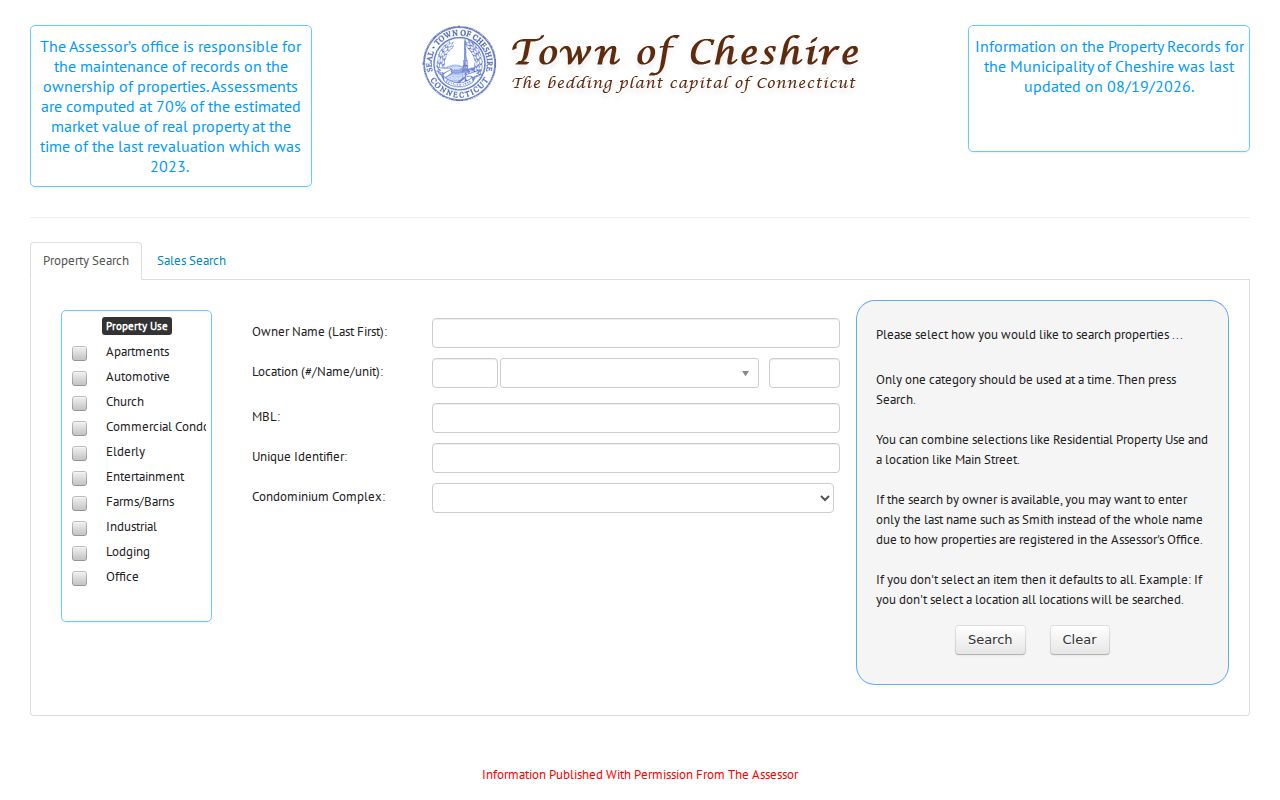
Results can show street name, number, unit, displayed name, unique ID, MBL, property use, acres, zone, buildings, and condominium complex. A blue street-name link opens the card. The assessor reports a 2023 revaluation, a 2025 Grand List mill rate of 31.36, and a next general revaluation scheduled for 2028. Assessed value is 70% of estimated market value at the last revaluation, so it is not a deed or occupancy guarantee.
| Field or control | What it tests |
|---|---|
| Owner Name | Last name and first name, with the site advising that a last name alone can be useful. |
| Location | Street number, official street name, and unit where applicable. |
| MBL | Map, block, and lot identifier used to bridge a parcel to a deed or map. |
| Unique Identifier | Assessor or GIS parcel key for a more exact match. |
| Property Use | Categories such as residential, farm, school, office, industrial, or vacant land. |
| Sales Search | Property type, date, price, acreage, MBL, zone, location, and building filters. |
From a Cheshire Name to a Resident Record
MapXpress is the second half of the parcel check. Its property search accepts Name, House No, Street, Parcel Id, and Unique ID. The public ArcGIS parcel layer also exposes MBL, map, block, lot, unit, situs, mailing, zoning, tax, appraisal, sale, voting, polling, and edit fields. The map is a spatial check, not a legal survey.
The Cheshire GIS property-search screen shows how a name or address becomes a parcel selection. It is especially useful when an assessor result has a similar street name or when a street crosses several civic districts.
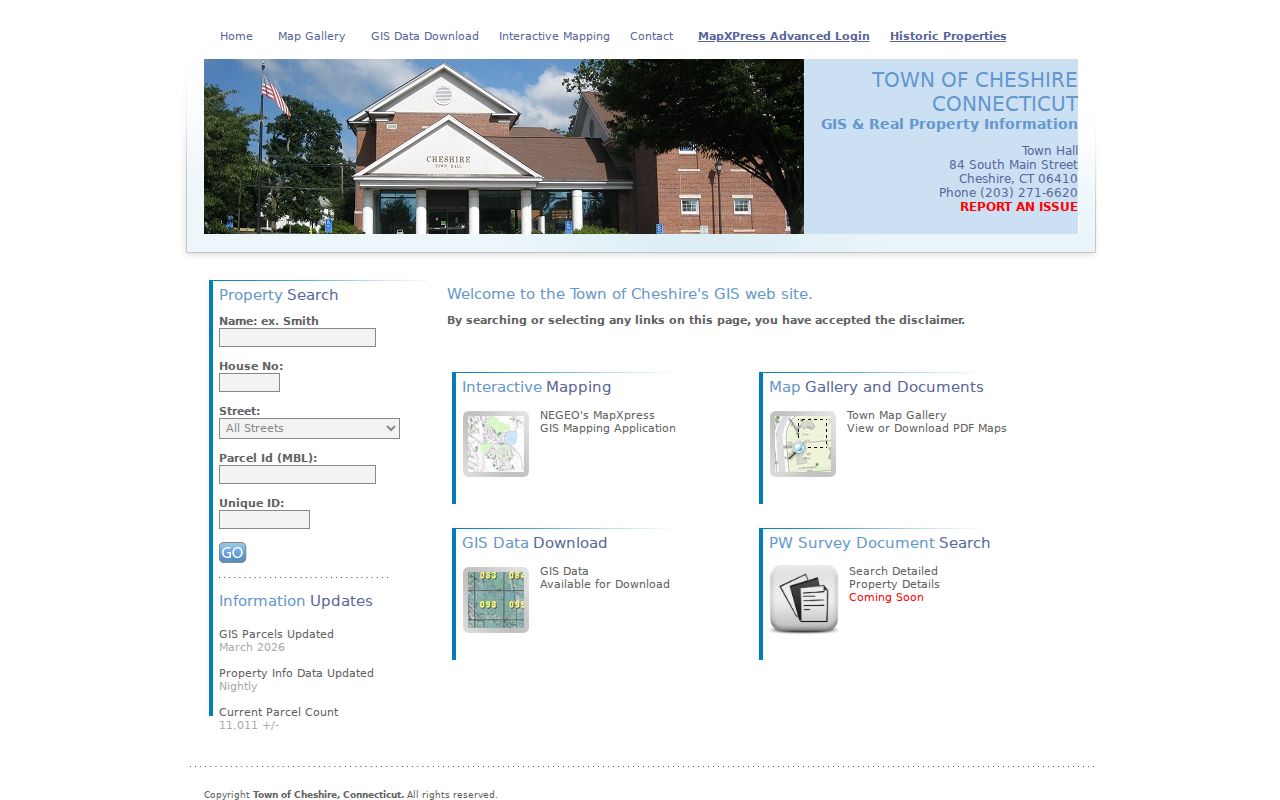
Read LOCATION and HOUSE_NO as the physical situs. Read MAIL_ADDR, MAIL_CITY, MAIL_STATE, and MAIL_ZIP as correspondence fields. A mailing address can be outside Cheshire and still belong to the parcel record. That distinction prevents a property owner, a tax mailing recipient, and a resident from being collapsed into one identity.
- Parcel
- A mapped land unit with a public identifier, assessment record, and geometry.
- Situs address
- The physical location used by the parcel and assessor systems.
- MBL
- Map, block, and lot notation that can link a card, map, and deed.
- Mailing address
- A correspondence destination that may differ from the physical parcel.
Current Cheshire Resident Record Sets
Current sources in a Cheshire residents directory are best read as separate rolls. Each has a keeper, an index key, and a limit. The table below shows what a result can support, not a promise that every person appears.
| Source | Who or what it shows | Keeper | Access |
|---|---|---|---|
| Assessor card | Displayed owner, situs, parcel, value, sales context | Cheshire Assessor | Free property portal |
| GIS parcel layer | Geometry, MBL, mailing and civic layers | Cheshire GIS / MapXpress | Free viewer and schema |
| Voter lookup | Registration information and lawful participation fields | Connecticut SOTS and Cheshire Registrars | MyVote, with privacy limits |
| Court index | Named party, docket, case type, dates, and available disposition | Connecticut Judicial Branch | Free online index, not official file |
| Library indexes | Historical names, notices, obituaries, students, and addresses | Cheshire Public Library | Research desk and citation request |
Official rolls and commercial compiled search tools are not the same kind of source. An assessor card has a municipal custodian and a parcel key. A commercial tool may combine stale public filings and marketing data, with unclear update dates and provenance. Use the official record for confirmation, then retain the source date and record type.
| Question | Best first source | What still needs checking |
|---|---|---|
| Who is tied to a parcel? | Assessor and GIS | Occupancy, mailing relationship, and current accuracy |
| Was a person registered? | MyVote or Registrar | Privacy rules, protected addresses, and current status |
| Did a named case appear? | Judicial Branch index | Clerk file, display window, and same-name risk |
| Did a household appear in the past? | Library, directory, newspaper, or yearbook | Date, citation, and original custodian |
Cheshire Resident Court and Voter Search Windows
The court and voter systems add resident clues, but neither is a general name roster. Connecticut civil and family searches can use party name, location, category, case type, sort order, and matching mode. Property-address searching can use town, street, ZIP, property type, and case status. The relevant state court route is the New Haven Judicial District, with public routing through Meriden GA 7.
The official Judicial Branch party search can search Starts With, Contains, Is Equal To, or Sounds Like. A case display may show a docket, filing date, party role, attorney, disposition, and available motions or documents. The online view is not the official file. Protected, juvenile, erased, and aged-out matters can be absent, so a no-result is not proof that no proceeding ever existed.
MyVote is a current registration-confirmation route. The public fields were not stable in the non-JavaScript capture, so do not promise a particular result layout. Connecticut’s current rule makes month and day of birth exempt, with only birth year public from the voter file under PA 26-1 §96. The full statewide file is a different request, costs $300, uses CSV delivery, and requires a permitted purpose and signed certification.
The Connecticut MyVote lookup and the SOTS voter privacy information should be read together. A street list can show odd/even address ranges and districts, but it is not a named household list.
The court portal capture comes from the Connecticut Judicial Branch civil search. It shows a public search surface, while the clerk file remains the official source for a docket or certified copy.
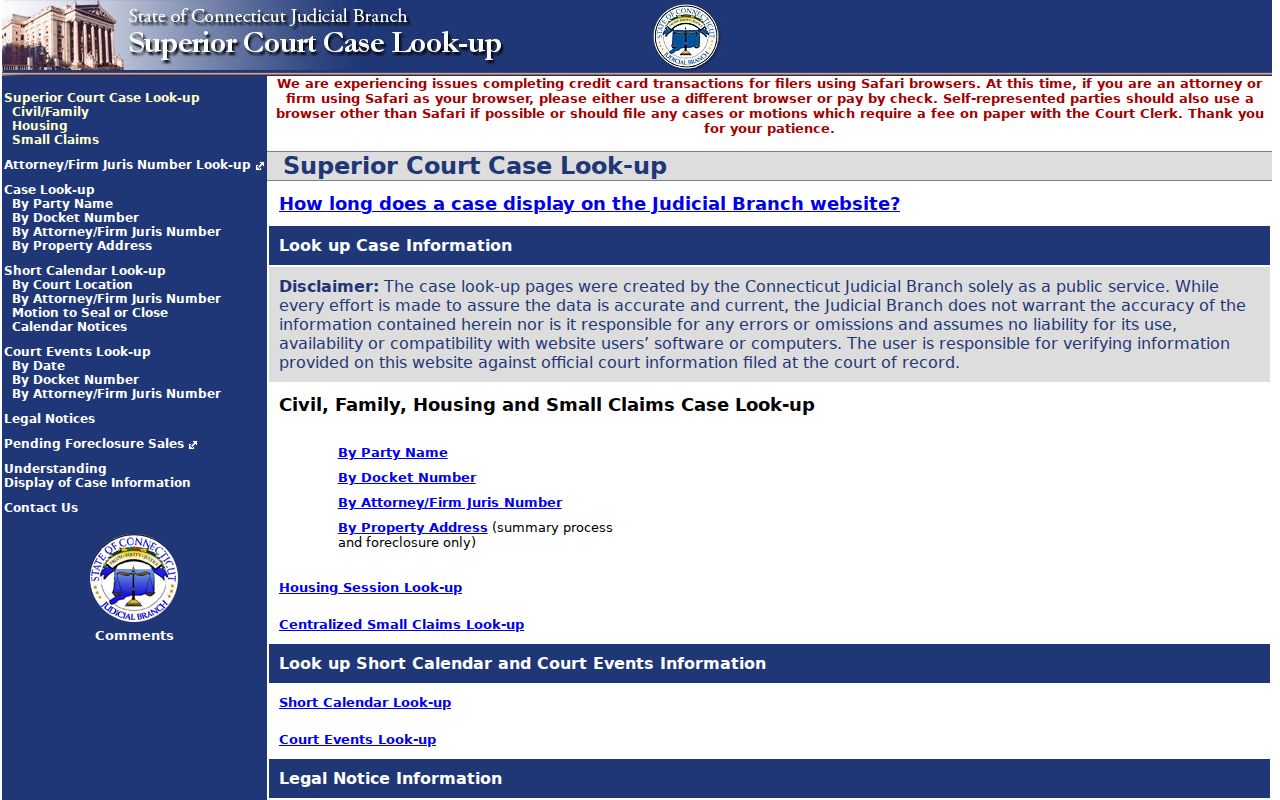
A court result is tied to a case and display window. It should not be read as a current address list or a complete history for a person.
The voter capture comes from the Connecticut MyVote lookup and is paired with the Secretary of the State voter-privacy guidance.
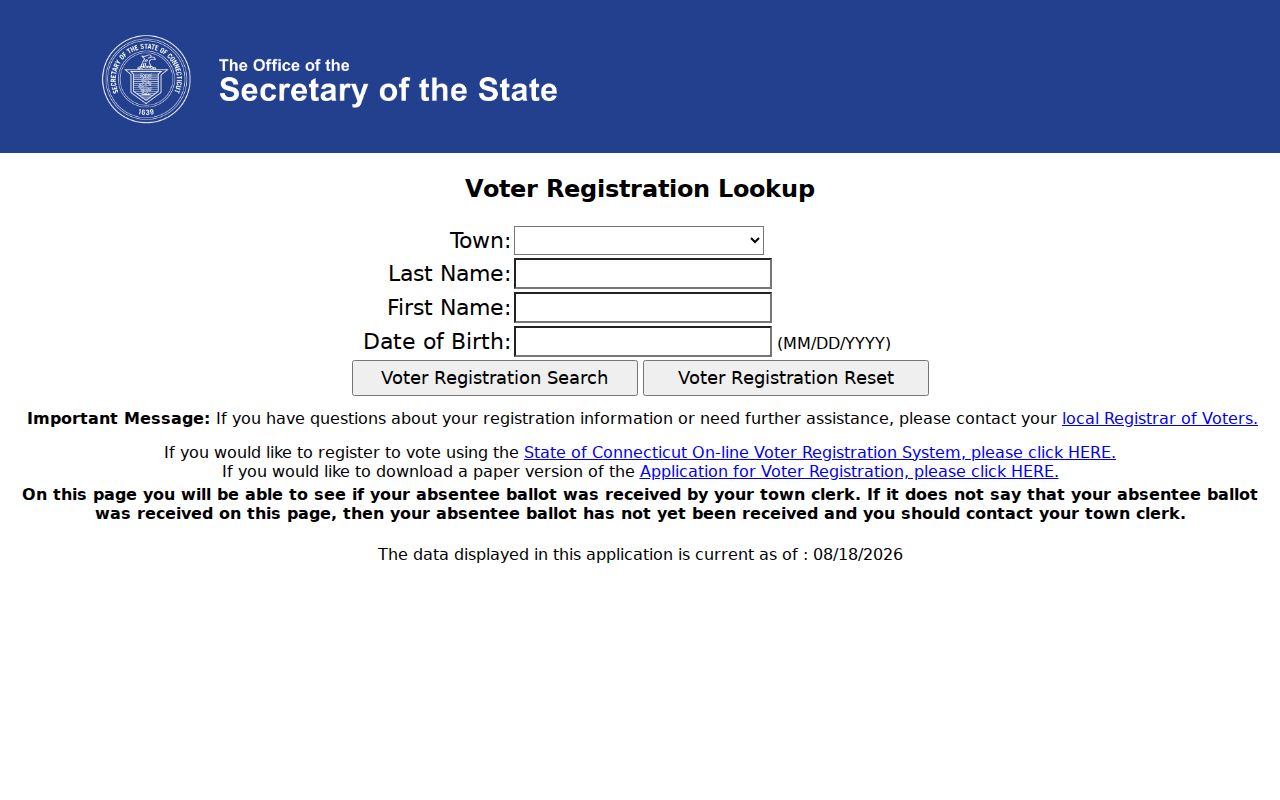
The voter image represents the current lookup route, not a downloadable resident roster. A protected address or incomplete result can reflect the privacy program rather than a search error.
Cheshire Birth, Death, and Marriage Records for Resident Research
Vital records need their own route because access changes by event. The Cheshire Town Clerk is the local registrar, while Connecticut DPH issues statewide certified copies and controls the forms and rules. A local event may be ordered from Cheshire or from the state, and the local office can be faster. DPH says state processing can take up to 12 weeks.
The Cheshire vital-records page lists $20 local birth full-size copies and $15 wallet-size copies, with ID and eligibility rules. State copies are $30 for birth and $20 for death, marriage, or civil union. Birth records less than 100 years old are restricted under CGS §§7-51 and 46b-25 and related rules. Death certificates are generally available to adults age 18 or older, with Social Security numbers restricted. Adults may request marriage or civil-union certificates, while SSN fields are limited to the parties.
The image below points to the Cheshire registrar route. The Permitium ordering portal launched on March 7, 2025 and adds a $7 service fee. A certified copy is evidence of an event, not a current residence record.
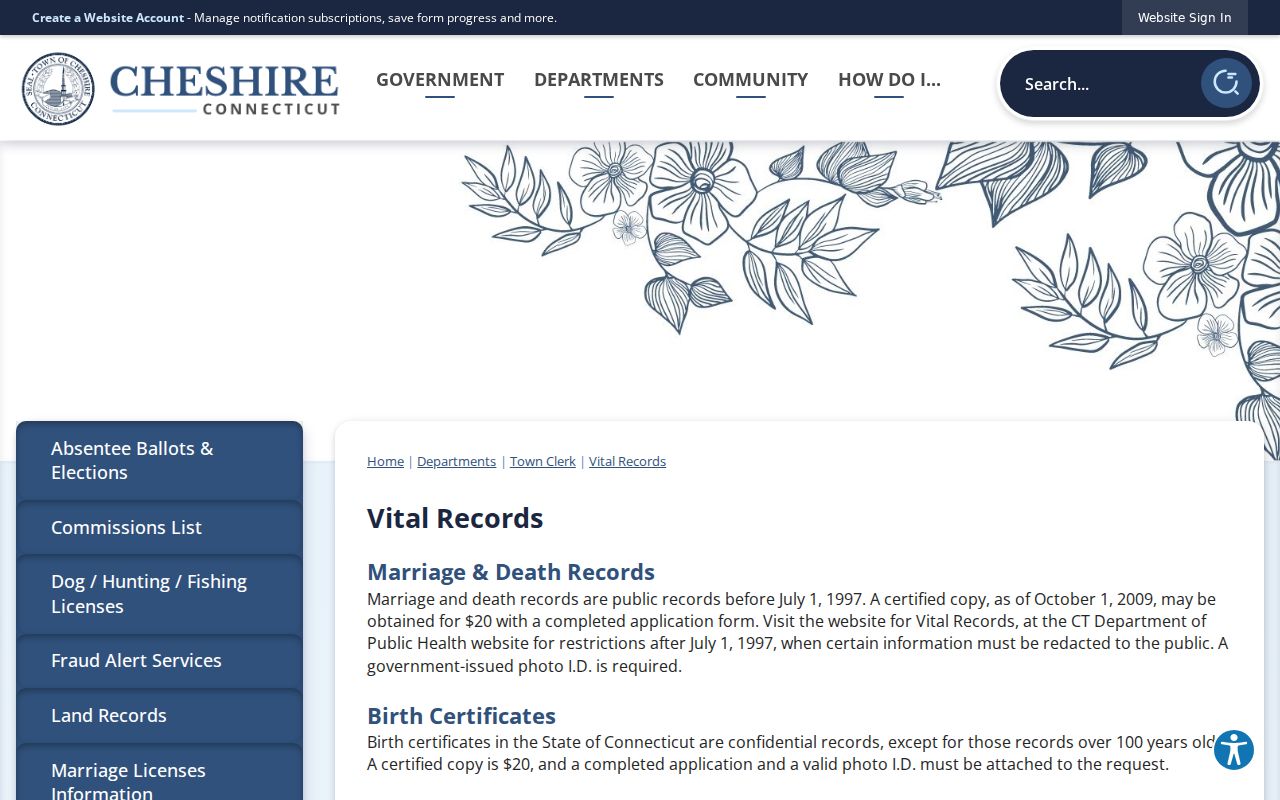
For older family research, pair the library’s Barbour and Hale references, cemetery inscriptions, and newspaper citations with the Town Clerk or DPH custodian. A library index is a lead, not a substitute for the certificate.
Cheshire Residents Directory Library Trail
Cheshire Public Library’s local-history collection is the best verified place to begin a historical residents directory search. It includes town, county, regional, and state histories, local family histories, city directories, Cheshire High School yearbooks, Hale cemetery inscriptions, and Barbour Connecticut town vital abstracts. The library can send a copy of an indexed article or obituary when a requester supplies a complete citation.
The Cheshire Newspaper Articles Index reaches from 1756 through 1922 but is not comprehensive and has gaps. The Cheshire Herald obituary index covers 1953 through 2015, with the A through R segment identified on the public page. Digital yearbooks begin with 1955. The library’s research page also lists Cheshire Herald 2006-present, New Haven Register 1986-present, Meriden Record-Journal 1997-present, Historic Hartford Courant 1764-1922, NewsBank, Ancestry Library Edition, and FamilySearch Affiliate access under library rules.
The Town Clerk view below comes from the Cheshire Town Clerk records hub. It shows why a citation request is often more useful than a broad name search.
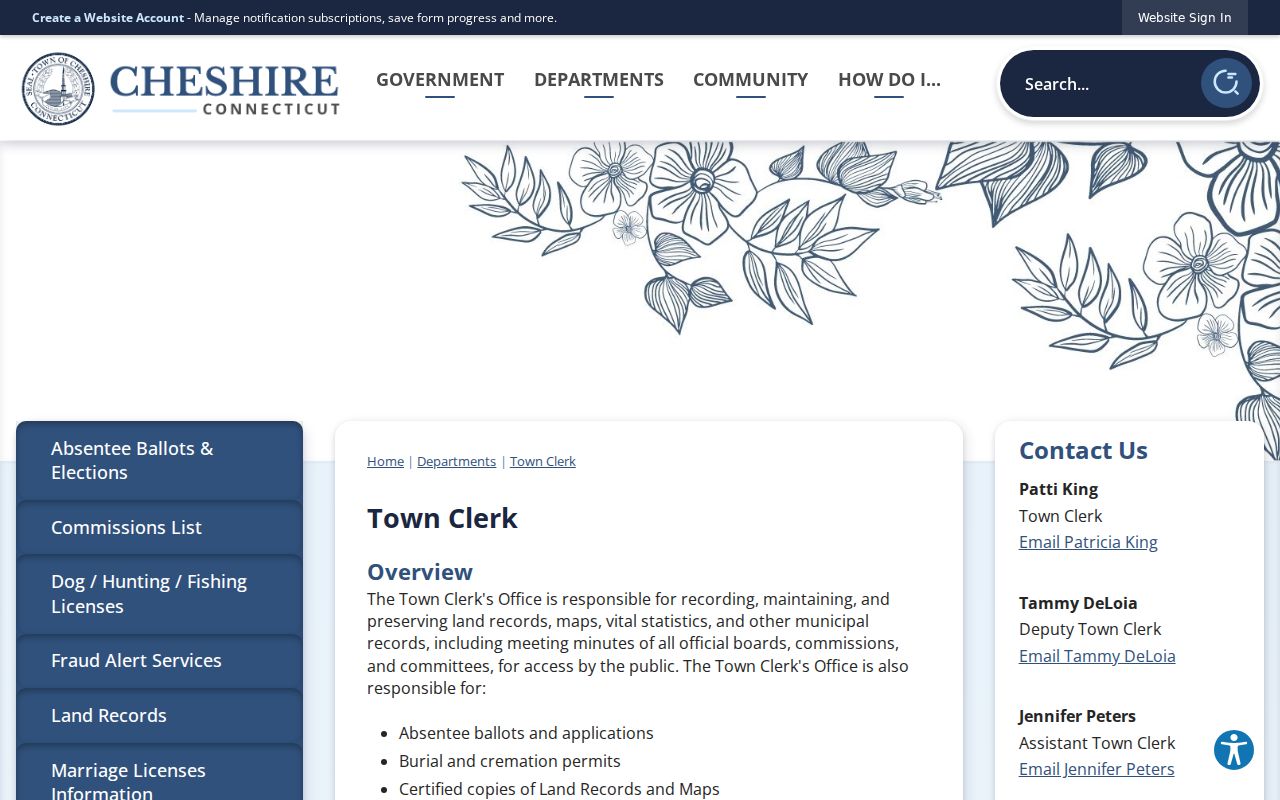
The Town Clerk page is the local fallback when a library citation points to a deed, map, or municipal record that needs a custodian copy. Library requests instead ask for a name, email, message, and the citation needed to locate the item.
Cheshire Streets, Districts, and 06410
Address geography adds another check to the Cheshire residents directory. The confirmed local postal row is 06410, associated with the Cheshire Post Office at 210 Maple Avenue. The research did not verify a second current ZIP serving Cheshire residences. A 06489 reference appears in an operational postal label context, not as a second Cheshire delivery ZIP.
Street and civic lines do not always match. The July 2025 voter street list splits Academy Road, Blacks Road, South Main Street, and South Meriden Road by odd/even ranges and voting district. GIS also separates physical LOCATION from MAIL_ZIP. Use USPS exact-address lookup for delivery, MapXpress for municipal parcel placement, and the street list for district ranges.
A Census ZCTA is a generalized representation of USPS service geography, not a municipal boundary. It can cross the Cheshire line and should not be treated as a count of Cheshire residents. The same caution applies to parcel counts. MapXpress reports approximately 11,011 parcels, while Census QuickFacts reports population context, not a search-result total.
When a Cheshire Online Record Stops
An incomplete portal is a signal to change access channel, not to fill the gap with a guess. SearchIQS may show an index without an image, and the live guest route was challenged during research. The Town Clerk can check office books, maps, copies, or the book-page reference. The Judicial Branch clerk can verify an official file when the online display is too old or protected. The library and Historical Society can supply a citation for an older name or property.
Cheshire’s FOI form asks for a date, requester name, phone, email, a specific document description, a delivery choice, fee agreement, and typed signature. One form is used per request. The Connecticut FOI Act, CGS §§1-200 through 1-242, especially §§1-210 and 1-212, governs inspection and copy rights, subject to exemptions. A request should identify the record and date range rather than asking for an undefined file about a person.
The image links to the Cheshire FOI request form. It shows a written route for records that remain in a department’s custody but are not exposed by a search screen.
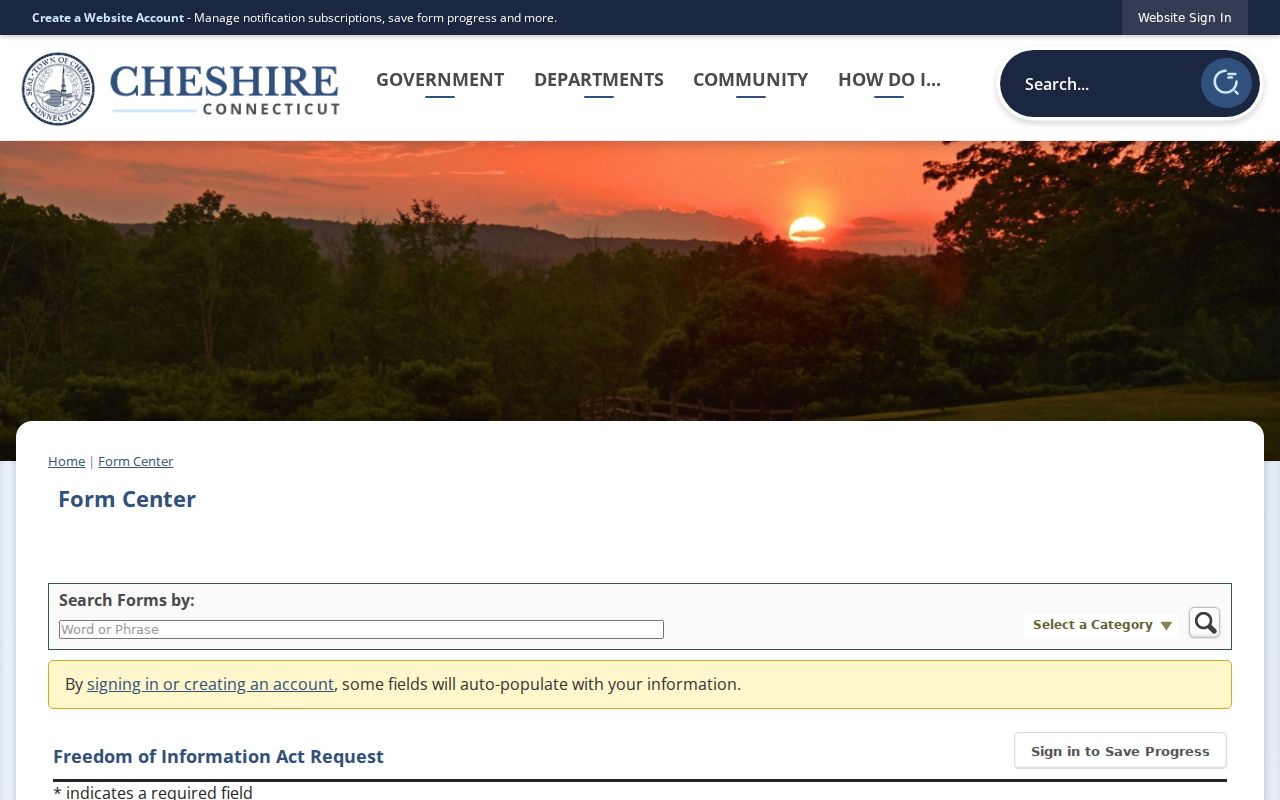
Keep the request narrow and ask the custodian which copy or certification option fits. Privacy exemptions, Safe at Home, voter privacy, and protected court or vital records still control the result.
Lawful personal use. Cheshire records can support family history, civic research, reconnecting, and house history. Public availability does not permit stalking, harassment, intimidation, or harm. Verify a record with its custodian and do not publish sensitive fields that are not needed.
Historical Cheshire Resident Directories Use Different Keys
A historical Cheshire residents directory entry is a dated snapshot, not a current address claim. The Library of Congress preserves a real Cheshire telephone-directory run labeled April 1954 through 1961/62, with name, street, exchange, and telephone structure. Local shelf directory years and publishers are not stated on the public library page, and exact reverse or criss-cross holdings need a catalog or staff check.
For a past household, keep the original year, page, address, and citation. Pair a directory with the 1950 census when the release rule allows, then test the trail with a newspaper or obituary citation, yearbook, deed, probate file, or cemetery record. The historical collections and how to read them have their own Cheshire city directory page, while current address work belongs on the Cheshire street directory page.
Note: A name disappearing from a directory can mean a move, death, non-listing, spelling change, or a gap in the collection.